For more than 170 years, farmers and shoppers have helped make Knoxville’s Market Square one of downtown’s most recognizable gathering places. Here’s how it started.
It’s harvest time, probably a good reason there’s a National Farmers’ Day on Oct. 12. Farmers are urgently important to every city, of course—they’re what keeps us alive—but cities have to come up with their own systems to get good things from farm to table. Part of Knoxville’s system is something we can observe every Saturday, at the Farmers’ Market of historic Market Square.
In its earliest days, Knoxville itself existed almost entirely as an administrative center, as capital of the Southwest Territory—and later, for about 17 years, capital of the new state of Tennessee—so Knoxville, as America knew it, was a tiny town dominated by politicians, clerks, printers, and tavernkeepers. On first glance, it wouldn’t seem to have much to do with farming. But farmers were always close at hand, growing crops on the east side, running gristmills on First Creek.
In 1800, the year of the first census that counted people who live here, only 387 people lived in Knoxville proper, which was then a tiny grid of streets clustered near the river bluff. It was a tiny village, but hardly isolated. By then, Knox County was already home to more than 12,000 people. Most of them lived on farms, many of them within walking distance of the courthouse. Regardless of whether they had other roles as doctors or lawyers or surveyors, most people in East Tennessee were growing things, whether corn or hogs or wheat or apples, both for their own families’ sustenance and to sell on the market. When they did so, they usually just loaded up a wagon and chose a busy spot to pull over. In a very small town, that might work. With growth, it might become a problem.
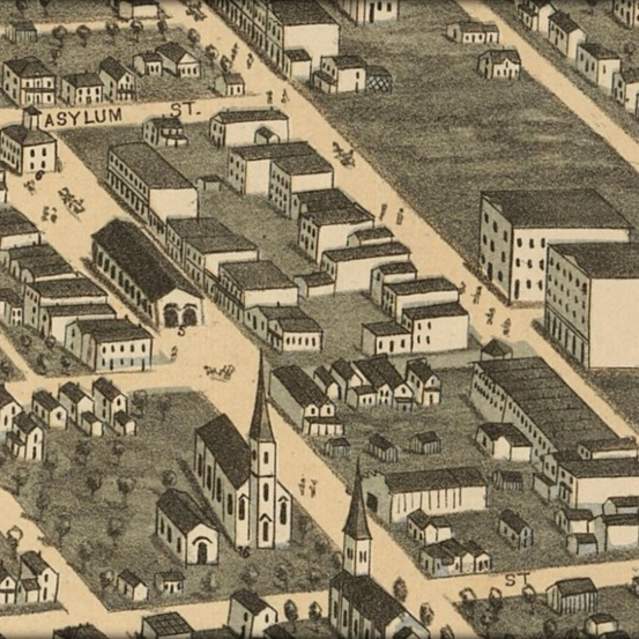
As capital, Knoxville was governed by the state until it elected its first Board of Aldermen in 1815. One of their first priorities was to establish a Farmers’ Market. They apparently did so on Main Street, building a probably small structure not far from the entrance to what’s now the City-County Building. According to the plan, it would be open Tuesdays, Thursdays, and Saturdays, limited to locally grown farm produce. It lasted only about seven years. By the 1820s, it appeared the wonders of the steam era were passing Knoxville by. River transportation was limited, and it looked like the new wonder of railroads might be very far in the future.
But when railroads were definitely on their way, the city began to grow. By 1850, farmers’ wagons were choking the dusty streets, and the city attempted to get an orderly handle on it by limiting produce sales to one side of Gay Street, and only one day a month.
As the first railroads arrived in the 1850s, the city more than doubled in size, and it was clear something had to be done to please both the farmers of the region and their ever-growing number of customers in downtown Knoxville. Two young brothers-in-law, Joseph Mabry and William Swan, both of whom owned some farmland, purchased some property on the northern part of downtown, and made the city a deal. They’d donate an acre and a half of the property for use purely as a public farmers’ market if they were permitted to develop the eastern and western sides of that quadrant. By 1854, they built a small brick Market House at the southern end of the public quadrant, and Knoxville began calling it Market Square.
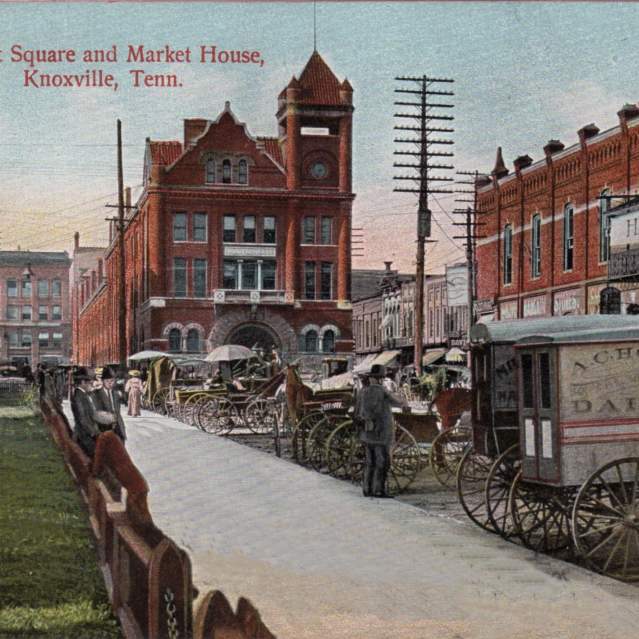
For the next century, it was perhaps the busiest place in town, especially during Harvest seasons. Everyone in town, regardless of gender, color, age, or wealth, came to Market Square to find the best produce. Some declared it to be the best food market between Norfolk and New Orleans. In any case, farmers came from as far away as Alabama to sell their produce at the best price, many of them traveling more than a day to get here. Some farmers, unable to afford a hotel, would sleep under their wagons, right on the square. Farmers from the mountains, like the Smokies' Cades Cove, were often suspicious of people in the city. They heard bad things happened here, and they slept with their money and a loaded firearm closed at hand. Remarkably, murder on Market Square was rare, perhaps because it was also the location of the police station.
In the summer, so much produce arrived on the Square, especially in July, when the big melons came in, that sellers had to spill down the street. The block immediately to the south was called Watermelon Row.
By Jack Neely
Image & Captions:
Map of Knoxville showing the first market hall, 1871 (detail). (Library of Congress.)
Farmers and their wagons, Market Square, circa 1930s. (Mark & Cindy Proteau Collection/KHP.)
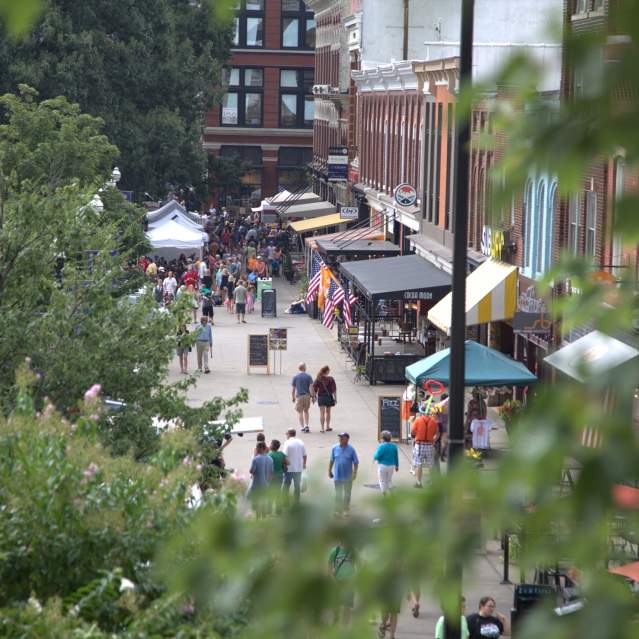
Farmers Market on Market Square (Alan Sims/InsideofKnoxville.com)
Visit the Market Square Farmers Market Today
More than 170 years after Market Square was established as a public market, Knoxville’s connection between local farms and downtown life continues.
The Market Square Farmers Market, operated by Nourish Knoxville, brings East Tennessee farmers, food producers and makers to the heart of downtown Knoxville throughout the year. During the 2026 peak season, the market operates Wednesdays from 10 a.m.–1 p.m. and Saturdays from 9 a.m.–1 p.m. through October. Beginning in November, the market transitions to its winter schedule, with Saturday markets from 10 a.m.–2 p.m. through March.
Visitors can shop for seasonal fruits and vegetables, meats, baked goods, plants, artisan foods and locally made products while exploring one of Knoxville’s most historic gathering places. The market remains closely tied to its original purpose: bringing the region’s growers and producers directly into downtown Knoxville.
While you’re here, make a day of it. Market Square is surrounded by restaurants, shops and entertainment and is just steps from Gay Street and other downtown Knoxville attractions!
Author
Jack Neely
Jack is the Executive Director of the Knoxville History Project, an educational nonprofit whose mission is to research and promote the history of Knoxville. He is a journalist who has been writing about his hometown’s character and heritage for many years. He has written several books about Knoxville and its history, and they can be purchased in various places throughout the city including Union Avenue Books and the Visit Knoxville Gift Shop.