It’s always fun to see how Knoxvillians first responded to things we now take for granted: football, pizza, opera, steamboats, bluegrass, soft drinks, Halloween, beer, etc. We can’t do that for coffee. Coffee was always here.
And that fact is surprising. Coffee has been here longer than democracy, but it’s a foreigner. Its beans come from an exotic plant unknown to Native Americans. The flowering shrub known as the coffea plant is believed to have originated in northeastern Africa. The drink made from it was known in the Islamic world for centuries before it caught on in Europe.
But it did catch on in a big way, especially in England, where it is credited with driving lots of new thoughts. Coffee got a particular boost in the mid-1600s during the puritanical reign of Oliver Cromwell, who banned alcoholic beverages.
Tea is another exotic plant, very different but also notable for its caffeine. It originated in China and India, but caught on in the English-speaking world about the same time, promoted in a big way by the seafaring British and the Dutch East India Co., which for generations was the primary supplier of Asian tea to the western world. Both coffee and tea became known in the American colonies, by which time coffea was being grown in Latin America and the Caribbean, especially Brazil and Haiti.
There’s an old assumption that may never die, that coffee became more popular in America due to the punitive tax that resulted in a little pre-Revolutionary insurrection called the Boston Tea Party in 1773. Coffee, they say, became the patriotic drink.
We don’t know about all the habits of early settlers, but a key figure, the guy who decided a capital city would be here and it would be called Knoxville, was Gov. William Blount, Revolutionary War veteran and signer of the U.S. Constitution. We have pretty strong evidence that he was a coffee drinker, thanks to a 1797 inventory, accessed for us by the folks atBlount Mansion(one of Knoxville's Historic House Museums), he’s known to have owned a “coffee pot.”
And by the 1790s, bags of coffee beans were being bought and sold in downtown Knoxville. However, so was tea. In fact, the first generation of Knoxvillians also liked tea. In the 1790s, the city saw more varieties of tea than of coffee. One of our few sources about the personal habits of early pioneers here is the little-known and somewhat fragmentary diary of Tennessee's first governor, John Sevier. The veteran of the Battle of King’s Mountain in the Revolutionary War and countless skirmishes with Cherokee and other native tribes has a reputation as a bold and violent soldier. In his diary, there’s more about “taking tea” with William and Mary Blount as well as several other prominent Knoxvillians than about fighting Indians.
Partly debunking the Tea Party patriotism hypothesis, historians have observed that the British tea habit remained popular in America during and after the Revolution, as proven by these two Revolutionary veterans, Blount and Sevier, so frequently “taking tea” together. Tea was probably more popular than coffee up into the mid-19th century.
By then, coffee houses were becoming a thing in the big cities, a place where men about town would gather to discuss the issues of the day. By the 1840s, Knoxville hosted at least one “coffee house,” as part of the old Franklin Hotel at Gay and Main. By the ads, it sounds as if they served as much liquor as coffee. In fact, some ads for that “coffee house” mention only liquor.
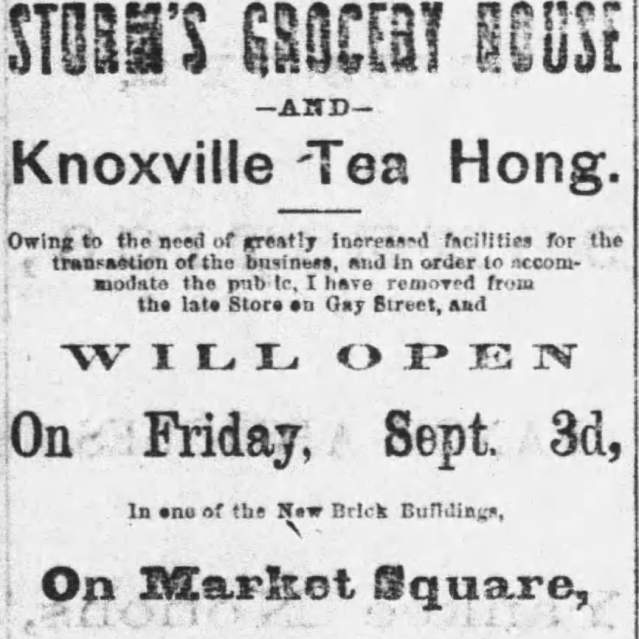
Soon after the Civil War, in 1869, an import-food store called Tea Hong opened on Gay Street, advertised with an exotic Chinese sculpture. Its proprietor was an immigrant, albeit not from China. Victor Hugo Sturm was said to be from Germany, though he also claimed to be French novelist Victor Hugo’s godson. Sturm had exotic stories, and exotic goods, selling delicious things from around the world, including coffee and tea.
Meanwhile, Horace Maynard, the second district’s first Republican congressman, became President Grant’s ambassador to the Ottoman Empire, where coffee had been almost universal for centuries. It was said Maynard returned to his home on Knoxville’s Main Street in the late 1870s with a taste for much-stronger Turkish coffee.
So Knoxville had coffee way back, but maybe didn’t get much excited about it. At least not until the 1920s.
That was when, in the middle of national Prohibition, Floyd Goodson moved to town. He’d grown up in Morristown, about 40 miles east of Knoxville, son of a well-known grocer named James Franklin Goodson, who sold all sorts of food. But due to his personal dissatisfaction with some suppliers, he went the extra step with coffee, and began roasting it himself, just for his grocery customers.
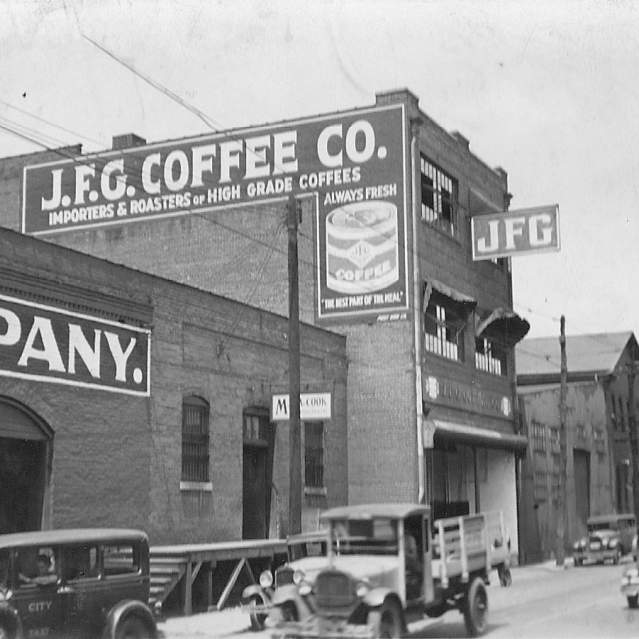
Mr. Goodson died in 1913. His son, a very young man, took over the business. He moved it to Knoxville in 1926, and set up on Jackson Avenue, the street alongside the freight yards that had always seen traffic in imported canvas bags of coffee beans. Shopkeepers from a five-state region would shop along Jackson to buy coffee in bulk for their stores at home.
National Prohibition had been enacted in 1919, and by the 1920s a lot of law-abiding Knoxvillians were looking around for something to drink that was both legal and exciting. Goodson found that Prohibition was a great time to go into the coffee business. He named his company in memory of his resourceful father, using his initials: JFG.
He began roasting coffee at a facility originally on East Jackson, very near the current location of the baseball stadium. In the mid-1930s, he moved it a couple of blocks west, into an old hat factory not far from Gay Street.
The business imported “green” coffee beans, roasted them, ground them, then sometimes blended the result with other varieties to get a perfect result. For 80 years, the northern part of downtown Knoxville smelled like roasting coffee. No one is known to have complained.
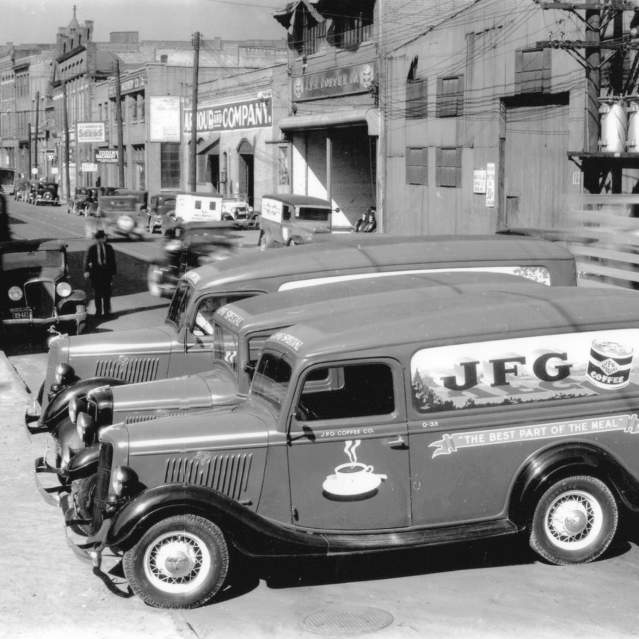
JFG eventually distributed their coffee across an eight-state region, mainly in the South. They had some in-state competition; Nashville’s Maxwell House, named for the historic hotel there, became a national brand. Maxwell House had a motto, “Good to the Last Drop.” JFG came up with a motto of its own: “The Best Part of the Meal.” It was adapted to radio jingles, and Knoxvillians of a certain age can still sing it.
Prohibition was also an era of “tea rooms,” which were cafes aimed mainly at women. The Blue Triangle Tea Room was hosted by the YWCA, the building still standing on Clinch Avenue. They became notable for lectures, meetings, and card games (bridge was the sensation of the era). The Blue Triangle was an early location for promoting the Great Smoky Mountains National Park. Run by the mother of artist Charles Griffin Farr, who later became a notable modern artist in the San Francisco Bay area, the Pollyanna Tea Room became known for exhibiting new artwork. The Pan-American Tea Room on old Vine Avenue was a tea room expressly for Black women. The Tinker Tavern, near what’s now the Sunsphere, claimed to have been a former home of British-American author Frances Hodgson Burnett, who lived in downtown Knoxville in the 1860s and ’70s.
Coffee never went away, but it suffered some indignities over the years. By the 1960s, it seemed very modern to buy instant coffee in a pungent mix, like Tang, that could simply become a cup of coffee by stirring powder into hot water. And then there was Sanka, instant coffee without caffeine. For years, it was the primary coffee option: “Just Sanka, please.” We still drank coffee, sometimes more than one cup, but didn’t think much about it. Coffee was something that came with a plate of bacon and eggs.
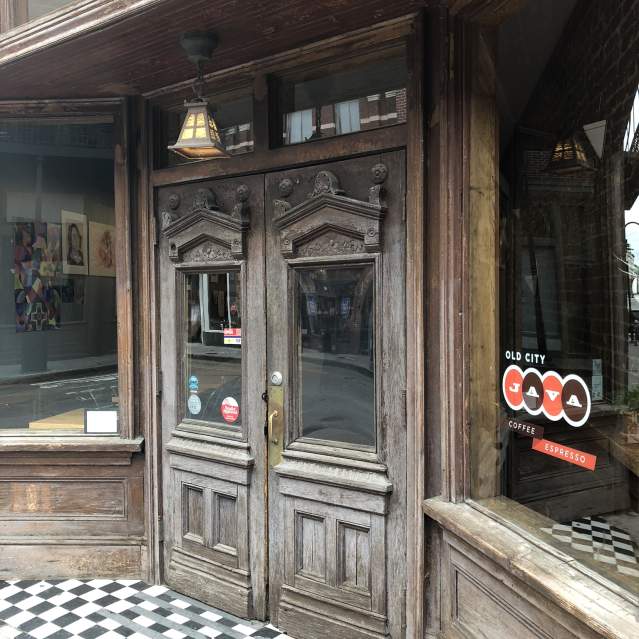
The modern coffee house, a place specializing in strong coffee regardless of its role in a meal, arrived in Knoxville only 35 years ago, with the first version of a place that has changed little. When Old City Java first opened in the Old City in 1990, several years before Starbucks got here, it struck some people as a strange fad. Coffee for connoisseurs? Seriously? We wondered how long it would last. But somehow people liked the idea. They’d come there on Sundays to read the paper. They started taking dates there after the show. Then having creative meetings there. After 35 years, Old City Java is still doing business, maybe now the oldest business in the Old City. And it now has a good deal of company all across town.
Sturm’s Grocery Store ad, 1869. (Knoxville Daily Press & Herald)
J.F.G. Coffee Company on East Jackson Avenue, circa 1930s (Post Sign Company Collection, Knoxville History Project.)
JFG Delivery Vans on E. Jackson Avenue, circa 1930s. (KHP)
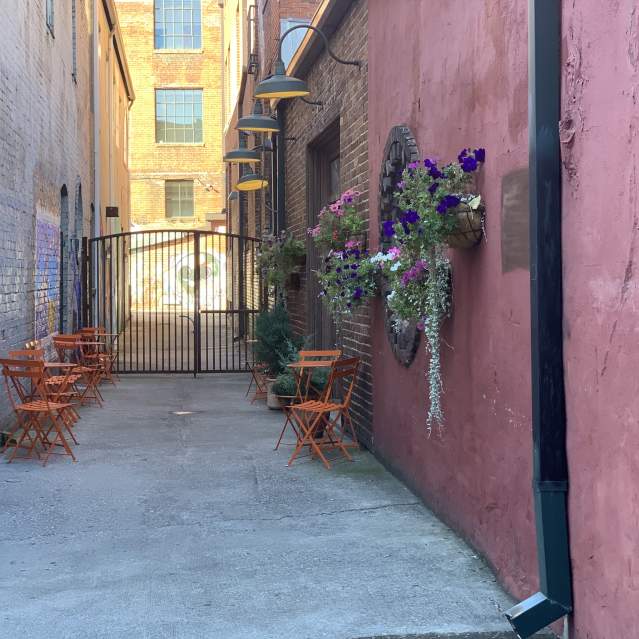
Header Image of JFG Building on E. Jackson Avenue. (Shawn Poynter for KHP.)
Author
Jack Neely
Jack is the Executive Director of the Knoxville History Project, an educational nonprofit whose mission is to research and promote the history of Knoxville. He is a journalist who has been writing about his hometown’s character and heritage for many years. He has written several books about Knoxville and its history, and they can be purchased in various places throughout the city including Union Avenue Books and the Visit Knoxville Gift Shop.