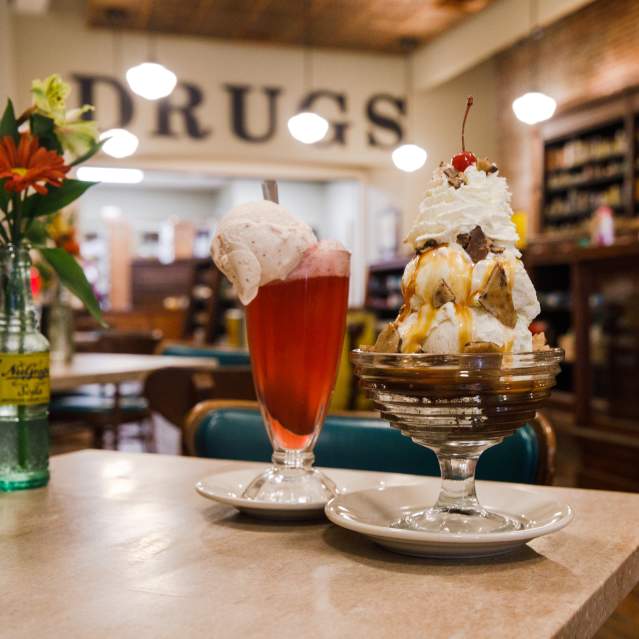
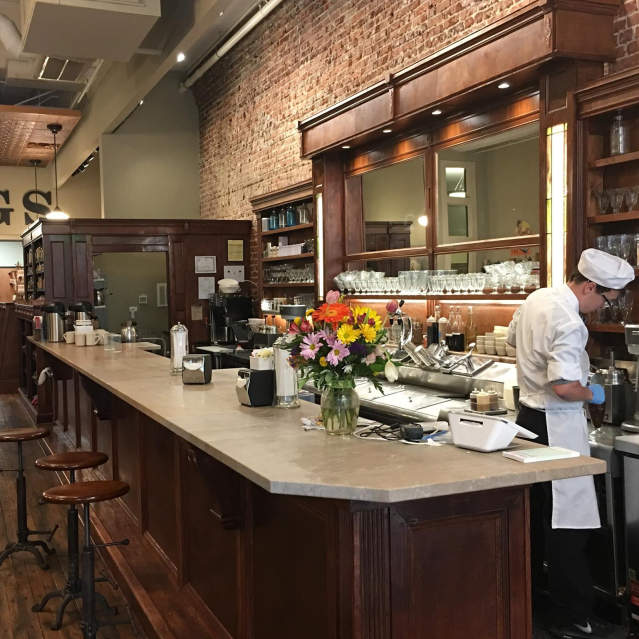
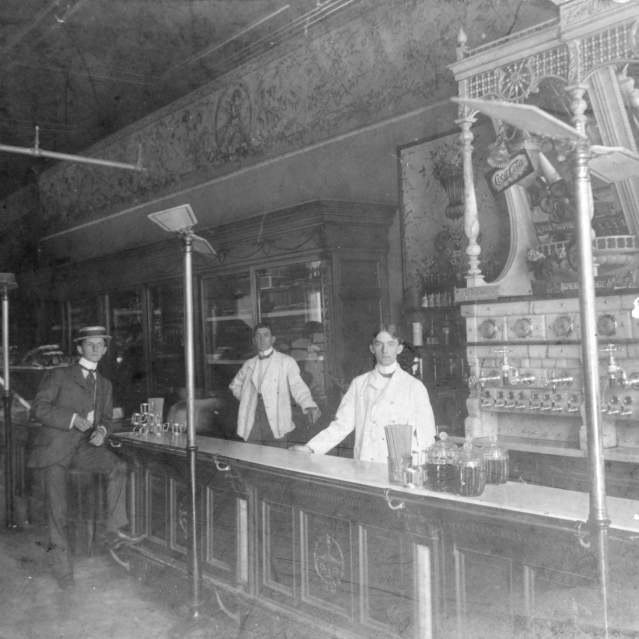
Ice cream has become one of downtown’s reliable attractions, and Knoxville has several fine ice-cream makers, some of which are so notably famous they form lines on the sidewalk on a summer day, but none of them more authentically old-fashioned than Phoenix Pharmacy on Gay Street. It’s an actual pharmacy, with pharmacists dispensing prescription drugs, but its popular front room is a soda fountain and ice-cream restaurant, skillfully evoked.
Of course, it’s not an actual historic pharmacy. Thirty years ago, its space was part of a J.C. Penney department store. But Phoenix has been there for nine years now, which may be long enough to seem historic to some people. People who enjoyed their first sundae there at age 9 are now college age, and may remember that as nostalgically as any of us.
It does evoke a real tradition, the soda fountain, that goes way back.
Knoxville soda fountains date back to before the Civil War, and in fact before the popularity of flavored soda pop. By 1849, McIntosh & Strong ran a drugstore with a soda fountain in downtown Knoxville, advertising only soda water created “by means of a new and improved apparatus.” That in itself was an irresistible novelty, advertised throughout that summer of ’49. As thousands of Americans, including a few Knoxvillians, were heading to California for the Gold Rush, on a grueling and often deadly trip, while back home, more sensible sorts were relaxing and enjoying refreshing beverages.
It evolved about the same time as another institution, unrelated at first, called the “ice cream saloon.”
That phrase often draws a chuckle, and may call for some explanation. Was it a joke? As it came to be understood in the 1840s, a “saloon” was a large, fancy, public room, set aside for rest or recreation, with some promise of comfort or elaborate décor. There were dancing saloons, museum saloons, bowling saloons. The “Blue Elliptical Saloon” was a public reception area of the White House.
It probably wasn’t until after the Civil War that saloon’s primary meaning was “bar.”
During Knoxville’s early decades, ice cream was something most folks had heard of. People with resources, like access to ice, servants, or a lot of spare time, sometimes made ice cream in very small batches. It took hours to make, and lasted for seconds.
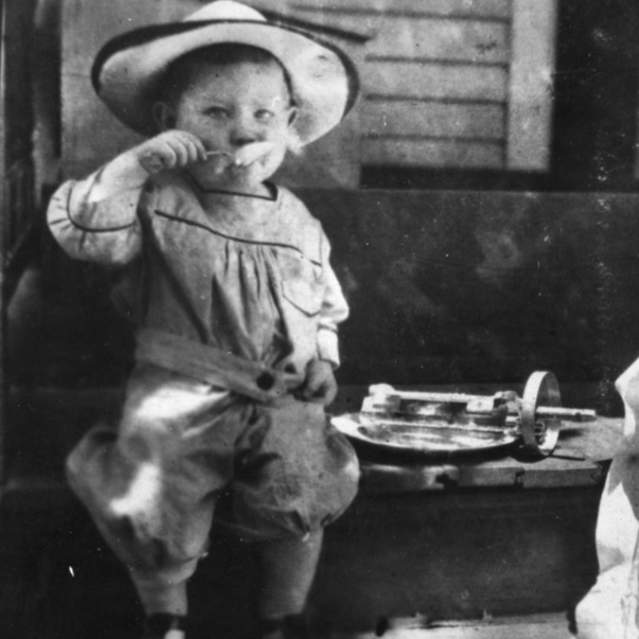
Ice cream probably wasn’t available commercially in Knoxville until about 1849. One big thing had changed, and that was the invention in 1843 of a hand-cranked ice maker invented by a Philadelphia woman named Nancy Johnson. Things got easier for ice-cream retail after that.
In Knoxville, a Capt. Council’s Ice Cream Saloon was reportedly a big attraction in the summer of 1849. Council, an obscure veteran of the war with Mexico, ran his establishment on the ground floor of the City Hotel. (That was the building soon to be known as the Lamar House; if you have dessert at the Bistro at the Bijou, you may be enjoying it in the same room where Capt. Council served his first scoops.) The following July, he got a rave in Knoxville’s Weekly Whig under the headline “Delightful Ice Cream.” The captain not only had wonderful ice cream, but “a cool and pleasant room in which to devour it!”
The same article refers intriguingly to “Losson, a man of color,” who ran an excellent ice cream shop nearby. We don’t know much more about him. Both Council and Losson seem to vanish soon after, at least as advertisers. It was a hard way to make a living.
However, within five years, another free Black man, Alfred Anderson, was selling ice cream on Main Street. In late June 1855, the Knoxville Standard gave it a try, with a bowl of Anderson’s product shared by the staff: “duly discussed by all hands,” it was “pronounced the best of the season…. We would recommend Alfred’s establishment to the young gentlemen during the hot weather, as ice cream is much better than a glass of brandy or a mint julep and costs no more, without the evil consequences of the latter.” He later gave up ice cream for something even more heavenly, to become pastor of the famous Logan Temple A.M.E. Zion Church.
In 1856, Ricardi & Nolan—Italy is famous for ice cream, and John (or Giovanni) Ricardi was one of our very first permanent Italian immigrants—were said to be “fitting up an elegant Ice Cream Saloon, where they will be prepared, on the first appearance of the sultry summer days, to accommodate the public with an excellent quality of the most refreshing article. They have completed an enlargement of their establishment and are putting up their Soda Fount.”
This may be the first evidence of an ice cream soda fountain combination. A reporter who signed him or herself as “K” visited Ricardi & Nolan on an evening, and reported, “The room was crowded with the beauty and fashion of the place, and their Cream is unsurpassed by anything in the city. The room is tastefully arranged—set up in fine style, and promises to be a pleasant resort for ladies and gentlemen who love to indulge in a dish of superior ice cream.”
It was said to be on Gay Street between Cumberland and Church, then the busiest part of town. Ricardi later set up his own confectionary on Market Square.
The following summer, another immigrant, Leon Chavannes, from French-speaking Switzerland, opened his “Ice Cream Saloon and City Restaurant,” at the northwest corner of Gay and Cumberland. Another business, Beaty and Thompson, had taken over the place by the summer of 1859, advertising discreetly separate rooms: a “Gentlemen’s Saloon” and “an apartment expressly fitted up for the accommodation of the Ladies.” Can’t be too careful.
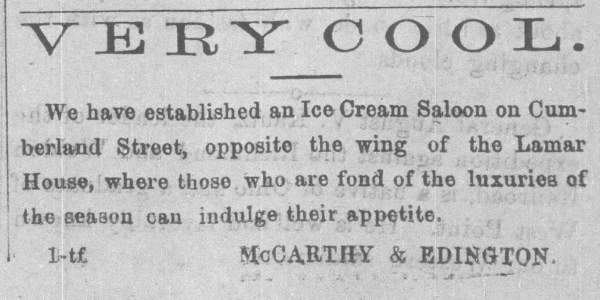
Then the war came along. When we think of the Civil War, we don’t always think of ice cream, but back then, some just couldn’t help it. In June, 1864, as Knoxville was under Union occupation and 400 miles to the northeast, Grant was battling Lee near Richmond, resulting in the deaths of 17,000 men, partners McCarthy and Edington had reopened Chavannes’ old ice cream saloon, “where those who are fond of the luxuries of the season can indulge their appetite.”
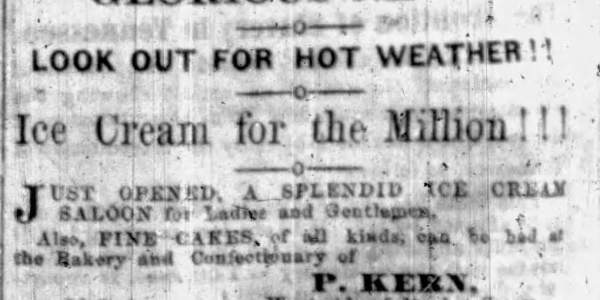
As word of the final Union victory got around, German-speaking immigrant Peter Kern, a refugee from chaos in Hesse-Darmstadt who had served in the Confederate army just long enough to get wounded, opened his ice cream saloon in May, 1865, with an ecstatic headline: “Glorious News! Look out for hot weather!! Ice cream for the million!!! Just Opened, a splendid Ice Cream Saloon for Ladies and Gentlemen.” It was on the west side of Market Square, where Kern would be a popular fixture for 40 years to come. He would become known as a bread baker and candy maker, but every summer, he was all about ice cream. It’s not surprising that the jolly German was later elected mayor of Knoxville.
Ice cream was never advertised, and maybe never available, except in the warmer months, from April or May until September or October. Some things were just understood. Although ice cream would have been easier to make in the winter, and slower to melt, you weren’t expected to think of ice cream except in hot weather.
Humans do enjoy a challenge.
Of course, we might wonder how they even made ice cream back then, especially considering there was no such thing as an electric freezer, and ice factories were not common here until the 1880s. Where did they get the ice?
There were no freezers, but there were “ice houses,” thickly insulated sheds where winter ice might last for a few months. And after 1855, there was ice coming in on the train. Advertised as “the purest lake ice,” it often arrived in insulated freight cars from the Great Lakes area. One of Knoxville’s best-known importers of ice was John Scherf, a German immigrant barkeeper, whose saloon was in the Lamar House—now the space known as the Bistro at the Bijou—the same building where Capt. Council was selling ice cream back in ’49. We’re just lucky it’s still there.
It took off, as so many other good things did, after the war. The three Spiro brothers were Jewish immigrants from the Austro-Hungarian Empire. They weren’t pharmacists, but confectioners, candy manufacturers. In the spring of 1869, they ran an endearing ad, remarking, “they have fitted up a neat soda fountain and ice-cream saloon, and rejoice to have their friends call.”
Their “ice cream saloon” was on the second floor, and open mainly in the summer months. It was on the 400 block of Gay Street, on the same side of the street as Cruze Farms’ popular ice-cream establishment.
They had competition. Peter Kern, their competition barely around the corner from the Spiros, was not to be outdone. Days after the Spiros’ first advertisement. “Peter Kern’s fine Arctic soda fountain is just now the centre of attraction. Ye who thirst, do not fall to go to Kern’s.”
But the following month, in June, 1869, another contender was in the fray, and this one was a pharmacy. Allison & French, a new and stylishly furnished drugstore at the corner of Gay and Clinch, and hardly a two-minute walk from the other soda fountains, “In the front of the store they have put up the most complete soda fountain we have ever seen,” according to the Daily Press & Herald, “and we would advise our friends to accept the kind invitation extended by this firm to call and take a free drink this afternoon and evening.”
The following year, 1870, Chamberlain & Albers, advertised that they were offering “First of the Season,” announcing they would “start their fine soda fountain today” on April 16, “and dispense the cooling beverage in all its freshness and purity.”
Peter Kern, though, was hard to beat, and the ice cream purveyor was remembered for years to come. His emporium of delights at 1 Market Square just seemed to get better and better. His ice cream saloon, located on the second floor of the 1876 building now known as the Oliver, offered dozens of carbonated soft drinks, but also Kern’s fresh ice cream. Decorated with framed art and chandeliers, with marble-top tables (and table service) it was open until midnight.
Knoxville had several more eras of ice cream to come. In the early 20th century, a Sicilian family named Armetta settled in Knoxville. After liquor saloons were banned in 1907, they moved into Patrick Sullivan’s old establishment at Jackson and Central, and began manufacturing ice cream by the name Liberty Ice Cream. Selling from that location and also catering church picnics and festivals all over the region, the Armettas developed a reputation as the champions of ice-cream manufacturing across much of East Tennessee, especially in the 1920s and ‘30s. When the light’s right, you can still read their painted advertisement on the side of the old saloon (now the Old City’s Lonesome Dove).
After that, bigger companies seemed to take over. Swift, a big company known for its refrigeration (and related to the meat company) began selling its ice cream in Knoxville, boosted in a big way by its success at the 1933 Chicago World’s Fair. Swift built its own factory on Fifth Avenue in 1936, manufacturing ice cream for a regional market there for 30 years.
Kay’s Ice Cream arrived the same year Swift built its Knoxville factory, concentrating more on retail ice-cream parlors all over town, with its extraordinary sculptures of giant ice-cream cones, with a statue of an eager boy climbing a ladder to give it a lick.
Everybody of a certain age remembers Kay’s. It was a Chattanooga import. K stood for Frank Kollmansperger, originally from Iowa, who ran the small chain. Knoxville was its first branch outside of Chattanooga, and eventually the Knoxville branch became semi-independent, with several of its distinctive stores in the Knoxville area.
We don’t have Kay’s or Swift anymore, and those older parlors run by hard-working immigrants around the time of the Civil War are now seeing other purposes.
Today, Tesoro Gelato, an Italian-style place opened in the Old City—just across the street from where the Armetta family made ice cream a century ago. On a hot night after a baseball game nearby, its line often spills out into the street.
Of course, today you can buy ice cream in any grocery store, any day of the year. But on a hot day, we can stand in line there or at Cruze Farm’s busy establishment on Gay Street, or relax in Phoenix Pharmacy's old-fashioned parlor, and imagine what it was like when it was a rare delicacy, available only in the summer.
Jack is the Executive Director of the Knoxville History Project, an educational nonprofit whose mission is to research and promote the history of Knoxville. He is a journalist who has been writing about his hometown’s character and heritage for many years. He has written several books about Knoxville and its history, and they can be purchased in various places throughout the city including Union Avenue Books and the Visit Knoxville Gift Shop.